
Today’s article is written by HazMatt, who made it to the final of the Grand Tournament (knocking me out of the semi-final in the process). I’ve added a few comments here and there:
Firstly, I would like to preface this by saying I am no statistician. I do not know if there are better ways to evaluate cards or even if the way I use is any good. But I do enjoy trying to break down cards and look for how they work and if they will fit in my decks and this is the framework I have been using to do so. Hopefully it helps or is of interest to some of you.
When I look at a card in Achroma and try to value it there are some simple numbers I like to use.
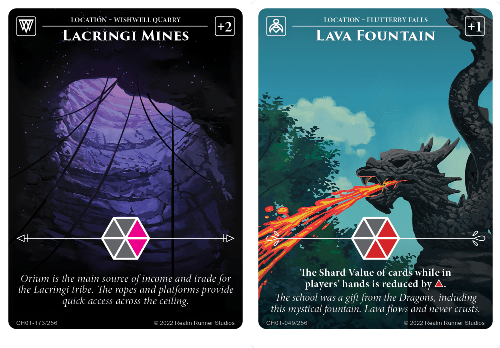
The first is what I like to call “return on investment” or ROI. This is simply how long the card takes to make back the Δ you pay for it. This is most important in games against an achrom deck because the better the ROI the less time you spend costing yourself Δ and the more time you spend gaining back the Δ they are trying to take! As a quick example: Lacringi Mines cost 2Δ but also returns 2Δ back to you on the turn you play it giving it a good ROI as you don’t lose any Δ the turn you play it. A card like Lava Fountain costs 3 and only returns 1Δ per turn, so if you ignore its ability it will take you 3 turns before you start seeing positives from playing it. If you want this card to match the effective ROI of 3/+3 cards like Rangled Wood, you need to be deploying at least 2 cards with red Δ every turn.
echo7: I use a very similar process, but also consider -Δ as if it were +Δ, as it’s pushing me towards my win condition at the same rate as gain does for a chroma player. So an Imp and Ravaged Elite have a ROI of 1, while Curdle Lane is 1.5. For steal I double the value, on the basis that the card effectively cost me that many fewer Δs and my opponent goes down that much. By this reckonining, The Seige of Draco Temple has a ROI of 1, while Brisgavi Falls is better than 1 and Glass Eel is 0.5, which is epic.

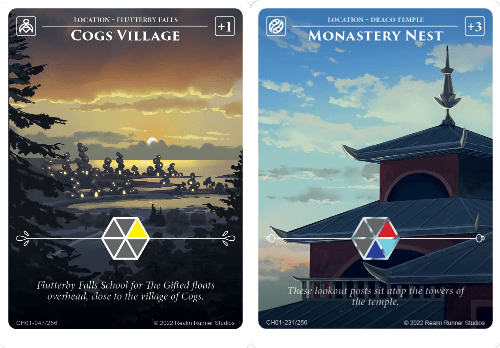
The second value is what I like to call “Profit”. This is how much progress towards 30Δ a card makes. If we take two cards with a 1 turn ROI: Cogs Village and Monastery Nest. A card like Cogs Village will only get you 1Δ a turn and so on its own could take as many as 29 turns to hit the chroma win! While something like Monastery Nest gets you 3Δ a turn so could be as many as 9 turns. I just break this down as Δ gained divided by total Δ to win (30). So 3/30 for the monastery nest gives you a profit of 0.1 or 10% while the Fairy meadow is only 0.03 or 3%. You can also loosely apply this to drain, steal and prevent but it doesn’t work quite the same way.
echo7: The way I look at profit for drain is in the same way as HazMatt does for gain. You can’t know how many Δ you’re going to have to chew through in a game, but 30 is a good ballpark, so a -3Δ card would have a profit of 10% (it gets me about 10% of the way to my win condition). Steal is trickier. I can’t really double the steal like I did for ROI, as it’s not moving me towards either win condition at double speed. For instance, Tenebris has ±3, which is a gain profit of 10% and a drain profit of 10%, but I wouldn’t say it has a net profit of 20%, as this card alone wouldn’t win me the game in 5 turns. If you don’t believe me, just imagine how oppressive Countess Issadora Curdle/Spiral would be if they had a natural -4, with -2 extra for each other character.
The “best” cards to have in your chroma decks are ones with a low ROI and a high Profit!
Now we have two solid ways of looking at how good a card is before putting them into your chroma deck! The next important thing to consider are any abilities a card has. If we take a card like Hex Clunker it costs 6Δ and only gives you 2Δ a turn, so it has a 3 turn ROI, and with that +2Δ gain it gets you 7% profit. If we look at just these two values Hex Clunker doesn’t seem to have very good value. However, it has the incredible ability to FIND or DIG for an object and deploy it for free. This ability has the potential to be obscene, especially when Rise of the Realm Runners arrives. Let’s take the Cintimani Stone which is coming out soon. You can not only find this 5Δ card and throw it out for free, you can then use its ability to DIG for a card and play that card for free. A combo I am looking forward to using is throwing a Fireball at one enemy character, then using Hex Clunker to dig/find the Stone, attaching it to another enemy character and using the action off that to recast your Fireball onto the character holding the stone ending with both Stone and Fireball in your dregs ready to do the same again next turn!
echo7: I truly believe that Hex Clunker will be one of the most, if not the most powerful card in the game in about a month when RotRR arrives.
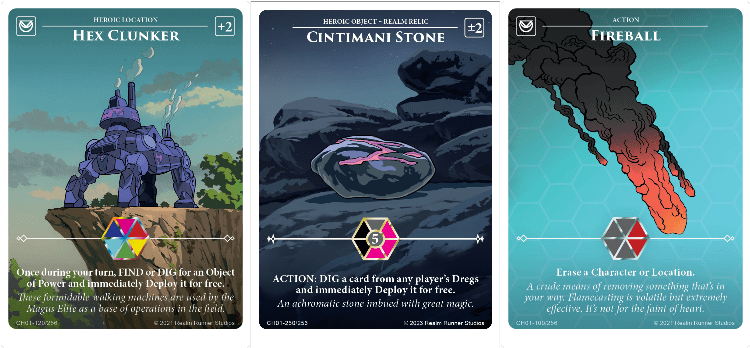
An ability like this each turn is clearly worth quite a few Δ! I like to assign abilities a value as best as I can and treat that as additional chroma gain. An ability like Hex Clunker I would say is as good as +4 for its versatility and power (this is pure opinion some people may value it more, others less). If we put that into Hex Clunker‘s valuation we now have a 6 cost that gives you “6”Δ a turn. Now it has a 1 turn ROI and 20% profit. A much more tempting choice for a deck!
echo7: I also factor in DIG, FIND and draw abilities even if they don’t allow you to play those cards for free, as cards in hand have effective value. Consider that when you trade for 3, you’re reducing your hand by 2 cards compared to how big it would be had you drawn instead. For that reason, I consider a card in hand to be worth about 1.5Δ, making Imp extraordinarily good value.
Of course this system for valuing cards has its limitations! It doesn’t really apply when it comes to ACTIONS. As these only fire off the once there isn’t as clear a way to handle ROI or Profit in the same way. Also, character have the ability to attack and be attacked, which isn’t factored in. And finally synergy won’t be applied. But this is the foundation I use. It is a starting point to start looking at if I should include a card in my deck or not, or to try and tie break between two cards I can’t decide on.
Do you have your own system for evaluating cards in Achroma? Share it with us in the comments or message me on Discord!
 Draco Temple