
Rise of the Realm Runners is now live on the achroma database. I will go over the highlights of the set soon (once I’ve finished building 101 new decks), but first I thought I’d examine the new keyword that’s had lots of players talking: DISPOSE.
After a couple of playtesting informed iterations, we have a clarification of this keyword which plays out in an interesting, clear, and interactive fashion. First off, I’ve got the ruling in full:
DISPOSE | Erase the card with the word DISPOSE. Once Erased, action the ability on the card. If this is during your turn, you may do this at anytime.
During an opponents turn, each time they declare they are deploying a card, using an ability (from a card on their Canvas) or declaring an attack, you may use DISPOSE once as Reaction. Once you have declared you’re using your DISPOSE, the DISPOSE effect happens first, then the original deployment, ability or Attack (if it can still happen).
When choosing to React in a multiplayer game, declare and resolve each use of DISPOSE in turn order, ending with the original player’s deploy, ability or Attack (if it can still happen). The original player cannot re-react to their own card being reacted to.
If by using DISPOSE as a Reaction, a new card would be deployed (E.g. Alchemist’s Tincture), the new card only gets played after all other deployments, abilities and attacks have concluded.
Reaction | A opportunity to use keywords like DEFEND or DISPOSE during another players turn. You may React only after an opponent has either: Declared they wish to deploy a card*, use an ability** (of a card on their Canvas) or declared an Attack***. Each other player may only React once per opportunity. See each Keyword’s description for specific details.
*”Declare you are deploying a card” includes showing the card to all players, paying its cost (shard cost and sacrifice cost) and declaring its targets (if applicable)
**”Using an ability” includes paying its cost (shard cost or dispose cost) and declaring targets
***”Declaring an attack” includes identifying the attacker and the defender of that attack
It’s clear that you can DISPOSE as many times as you like in your turn without using up your 3 deploy slots, but the new reaction mechanic opens up some really interesting interactions. To show this interactivity in all it’s glory, I’ve come up with a few examples. Note that I’ve had these all confirmed by Charlie aka Viridian, and I’ve included a few of his comments:
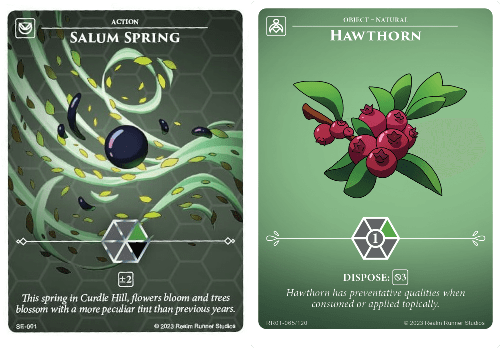
An opponent declares they’re going to steal 2 from you (using a card ability or by deploying an action like Salum Spring). Use your Reaction to DISPOSE Hawthorn and instantly block the lot.
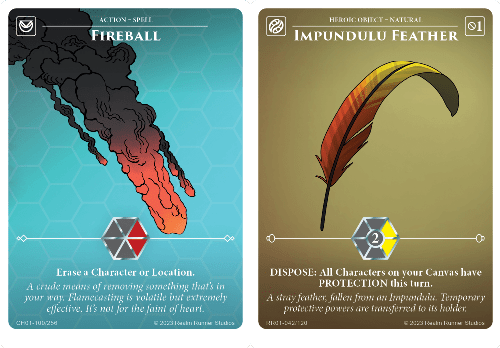
An opponent plays Fireball to attempt to erase a key character. You use your Reaction to DISPOSE Impundulu Feather to PROTECT that character. Fireball is still played, the opponent is still down 2Δ, but they get nothing. Impundulu Feather could easily be one of the most powerful cards in the game, and it has a natural 1 block built in.
Viridian: Impundulu feather is a fantastic once off protection to help against pesky actions and abilities like that.
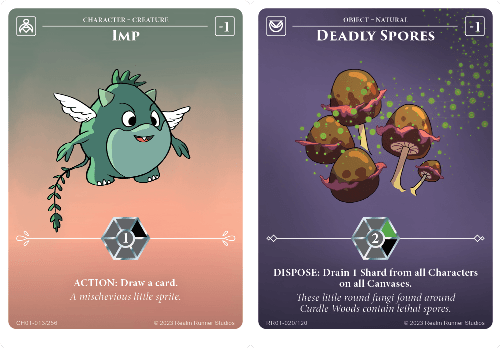
An opponent declares they are depoying Imp and spends 1Δ. Use your Reaction to immediately DISPOSE Deadly Spores and erase it. This happens before the ACTION on the Imp so they don’t even get to draw a card.
Viridian: The opponent should have known better to play the card when they could see Spores is on the board. But consider this: they may play that Imp HOPING you use your Spores, so they can play their next and more important card without the Spores now being there. Basically baiting out DISPOSE is going to be a good strategy.
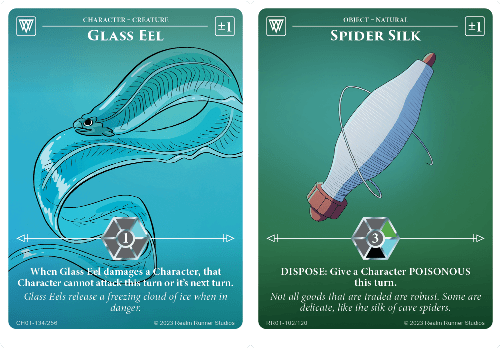
An opponent declares that they are going to attack your little Glass Eel expecting an easy win. Use your Reaction to DISPOSE Spider Silk to give it POISONOUS and take down the opponent’s character at the same time.
Viridian: Again another example that the attacking player can SEE you have that Spider Silk, so they knew the risk they took by declaring an attack. In the same way you can see if someone has a DEFEND card.
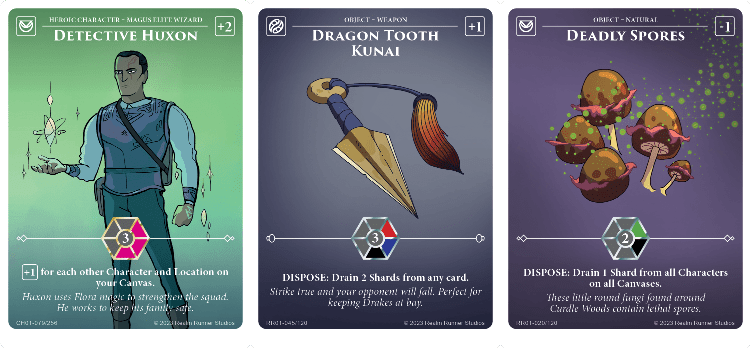
A player in multi-player plays Detective Huxon, giving them enough gain to win the game. Going in turn order, the next player uses their Reaction to DISPOSE Dragon Tooth Kunai, draining 2Δ from Huxon, leaving him on 1Δ. Seeing what the player before them has done, player 3 whose turn it is next to use their Reaction decides to DISPOSE Deadly Spores, draining 1Δ from all Characters on all Canvases, which includes finishing off Huxon. Great teamwork!
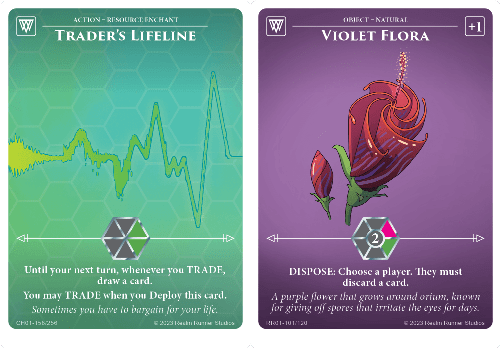
An opponent plays Traders’ Lifeline with only one more card left in hand. Before they trade, you use your Reaction to DISPOSE Violet Flora. This forces them to disacrd their last card before they get the action of Trader’s Lifeline to trade that card in their hand.
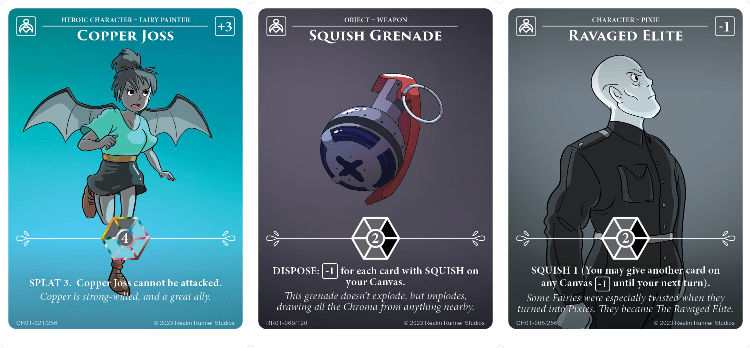
Your opponent spends 4Δ of their remaining 5Δ on Copper Joss, leaving them on 1Δ, but expecting to get 6Δ back. You use your Reaction to DISPOSE Squish Grenade, and since you have Ravaged Elite on the canvas, you drain them to 0Δ and win the game.
Viridian: Better not leave yourself low when a Squish Grenade is out!
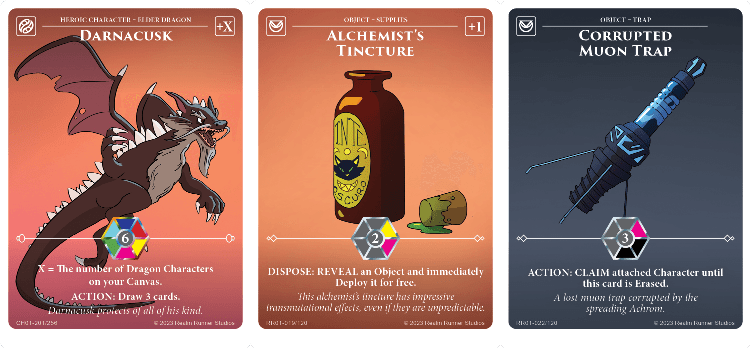
An opponent declares they are deploying Darnacusk, planning to get a huge gain in the Resolve step. You use you Reaction to DISPOSE Alchemist’s Tincture to REVEAL a Corrupted Muon Trap. As this card cannot be played before Darnacusk‘s ACTION resolves, the opponent draws 3 cards. Then with all other ACTIONS now concluded, the Corrupted Muon Trap CLAIMs Darnacusk.
Viridian: You can still use Tincture in this way (it’s why its still an incredible card) as you can still CLAIM him before any further cards or resolve is completed.
The clarification of this keyword also highlights some things you cannot do:
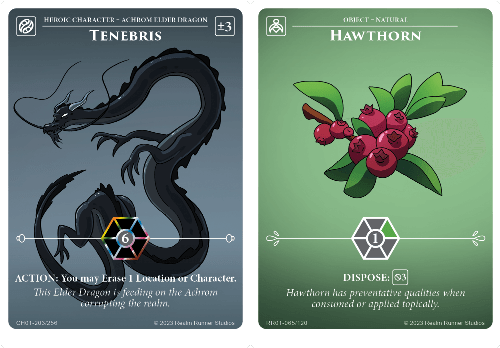
You cannot DISPOSE in Reaction to a card Resolving (or to Drawing/Trading):
If you’ve got a Hawthorn out, you can only DISPOSE it to reap the block 3 effect as a Reaction. Therefore, if the opponent has Tenebris on their canvas, and in their turn they simply Draw/Trade and then Resolve the steal 3, you cannot block it with Hawthorn.
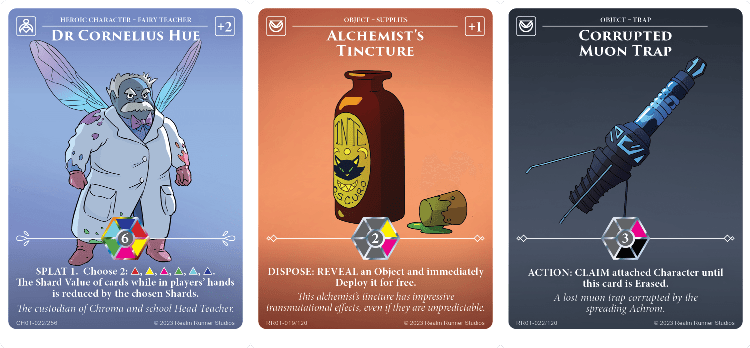
You cannot deploy a card during a reaction. It waits until the first action is complete:
If the opponent attacks with their Dr Cornelius Hue, you can use your Reaction to DISPOSE Alchemist’s Tincture, but if you REVEAL a Corrupted Muon Trap, you can’t play it until the attack fully resolves. So the end result is you’ve disposed your Tincture, revealed the Trap, the attack goes off (and likely your Character has been erased) but then once the attack has concluded, you can deploy the Trap and CLAIM Hue for yourself
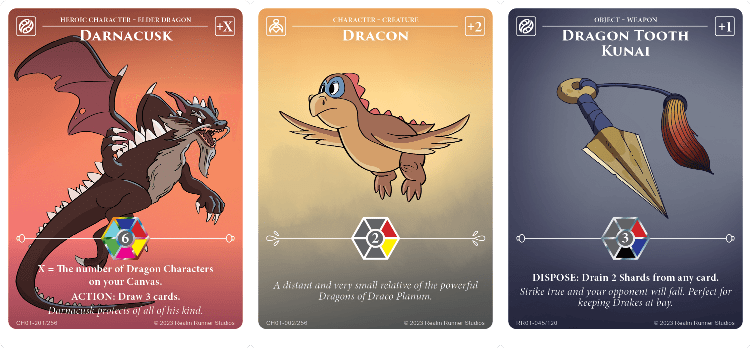
One player cannot react more than once to an action:
If the opponent attacks with Darnacusk against your Dracon, you cannot take two Reactions to DISPOSE two Dragon Tooth Kunai to drain Darnacusk to 2Δ before the attack resolves.
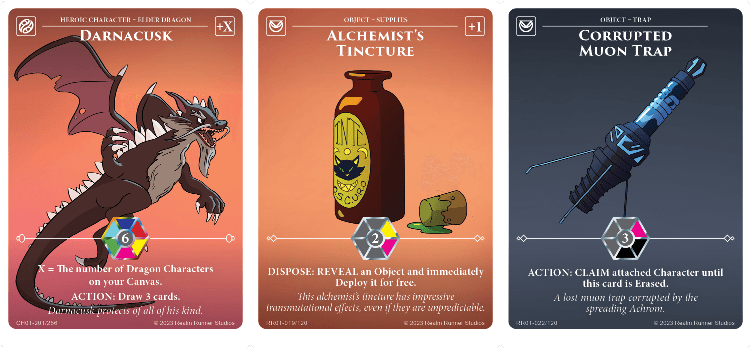
You cannot DISPOSE whenever you feel like it in an opponent’s turn. It has to be as a Reaction.
Going back to the earlier Darnacusk/Corrupted Muon Trap example, if you DISPOSED Alchemist’s Tincture in Reaction to Darnacusk being deployed hoping to hit a Corrupted Muon Trap, but instead hit another Alchemist’s Tincture, you couldn’t DISPOSE that one right away. You could however do this in a Reaction to another deploy by the opponent. As you cannot React to a player resolving a card, a wise player would skip straight to the Resolve step and Resolve Darnacusk without using any more card abilities you could React to.
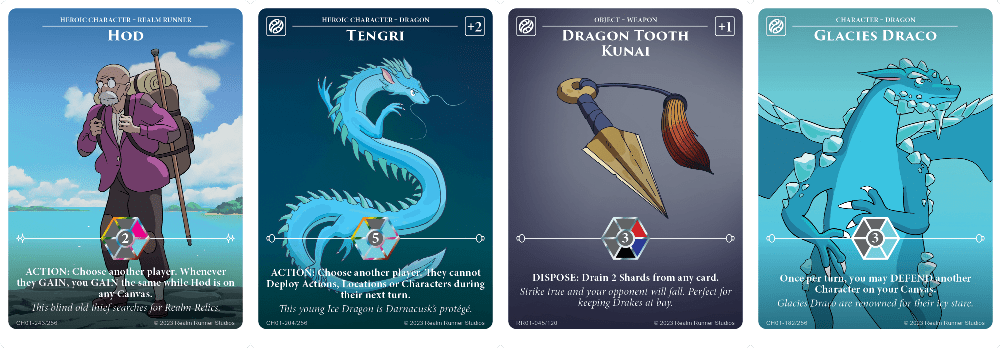
If a player declares an attack, you can DEFEND or DISPOSE as your Reaction. But you cannot do both.
You opponent declares they are attacking your Hod with their Tengri. You’ve got a Dragon Tooth Kunai attached to a Draco Hatchling, and a Glacies Draco on your canvas. You’d like to DISPOSE the Kunai to drain 2Δ from Tengri then DEFEND with the Glacies Draco to erase Tengi. But you cannot, as that would be two Reactions. As your one Reaction, you can either DEFEND with Glacies Draco or DISPOSE Dragon Tooth Kunai, but you cannot do both.
This last example illustrates another interesting point about Reactions: if you chose to DEFEND with Glacies Draco, Tengri would be down to 2Δ. If the opponent then deployed any cards, or declared any Attacks, you could React by DISPOSING Dragon Tooth Kunai to finish off Tengri. The only way the opponent could save Tengri from erasure, would be to Resolve, Draw/Trade, then end their turn.
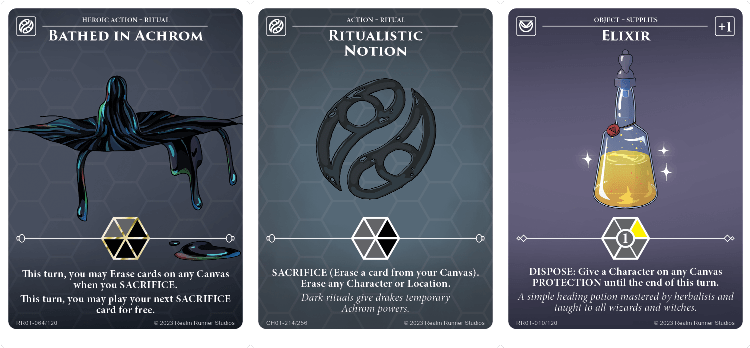
You cannot DISPOSE as a Reaction to prevent a SACRIFICE:
A player plays Bathed in Achrom and you’ve got 2 characters on your canvas you don’t want erased. You’ve got an Elixir on your canvas and would like to use it to PROTECT one of them. However, if you wait until they deploy Ritualistic Notion, they get to SACRIFICE one of your characters before the Reaction window. This is because paying shards, declaring targets, and sacrificing are all part of declaring you’re going to deploy a card. If they SACRIFICE the character with the Elixir attached, you don’t get to DISPOSE it. However, if your Elixir is attached to another character, you could DISPOSE it to prevent the Erasure that results from Ritualistic Notion as a Reaction.
Similarly, you cannot prevent a sacrifice by erasing an opponent’s card they wish to sacrifice, through an effect such as Dragon Tooth Kunai or Deadly Spores.
Hopefully these examples demonstrate how powerful this keyword can be, as well as its limitations. Viridian also adds “the main thing to note is that because DISPOSE is something that is not hidden, players should be more careful with what they play, knowing that DISPOSE cards are on the board and could be used”.
Have fun.
Next time you’re ordering achroma products, please use the exclusive discount code dracotemple at checkout on the achroma webstore for 10% off all orders, including pre-orders.
To activate this discount, enter the code at checkout, or go to shop.achroma.cards/dracotemple to automatically apply the code.
 Draco Temple
One Comment Add yours