A discussion on discord recently about value of cards in Achroma got me thinking: ignoring other abilities, in terms of pure net return on investment, what are the best value cards in the game?
First off, I need to define value, and by that I mean I’m going to focus on the resolve of a card, ignoring additional abilities. I’m also going to focus on cards that deploy directly to my canvas, so characters and locations only.
I’m going to also equate steal and drain with gain by quantifying net gain. The balance of shards is the same whether it’s +2, ±1, or -2, so I’m going to consider these equivalent. I know that’s a simplification, as drain/steal impacts the opponent’s ability to deploy cards, and the wincon for achrom is closer at the beginning of the game. It also ignores prevent. But I’m aiming here to define the best value cards in the game, and I don’t want to have a category for each Achroma effect.
On this basis, a card with 3Δ cost and +3 (such as Monastery Nest) has a net value of 0 on the turn it’s played, and +3 thereafter, which I’ll shorten to 0/+3.
A card with 1Δ cost and +2 (such as Senna) has a value of +1/+2.
A card with 2Δ cost and ±1 (such as Tarni River) has a value of 0/+2.
A card with 3Δ cost and -2 (such as Danra Drake) has a value of -1/+2.
While I’m ignoring card abilities, I will include additional abilities that always trigger, such as Chroma Storehouse which has a minimum of +2 as an ACTION, costs 3Δ cost and has +2, so comes out as +1/+2 (even though in reality it’s often more like +5/+2). I’ve also decided to count SPLAT 1 and SQUISH 1 as an extra +1.
So what are the highest value cards in Achroma?
Turn 1 winners:
Locations and characters with the highest on-play resolve, sorted by realm, are:
Chroma Storehouse (+1/+2), Haskus (+1/+4), Senna (+1/+2), Quin (+1/+2);
Trainee Painter (+1/+1), The Fallen (+1/+4);
Brynhild of Brisgavi (+1/+4), Brisgavi Falls (+1/+4), Glass Eel (+1/+2);
and of course the inimitable Ray (+4/+5).
Looking at that list, it’s apparent that Salum have no characters or locations that give you back more than their cost on the turn you play them.
The other thing to note is how far removed from the power curve Ray is. 9 cards in the entire game give you +1 net shards on the turn they’re played. Ray gives you +4! Even if you have to find him with Firetender, the combo of the two equates to +2/+6. It’s no wonder he’s so popular.
Long term winners:
More interestingly, let’s look at longer term return on investment. To help with this, I’ve done some analysis. What I did was create a spreadsheet with all the turn-by-turn net shard gains of all cards in Achroma. I then sorted the cards from each realm in terms of return in investment. I then removed all but the first legendary, all but the first 4 rares, and doubled up on all the non-heroic uncommons and commons, to make it more repesentative of a genuine palette/boardstate. That way we can see what the combined effect of playing the best cards each realm are on your shard total across turns 2 and 3.
What this means is, I can compare the best cards across realms, and use it to work out what realm has the best cards in terms of maximum shard value, ignoring other effects and abilities.
The results are in a graph. Along the x-axis is number of cards played, starting from the best value cards down to the 20th best value card in that realm. Up the y-axis is how many shards you would be on after 2 turns if you played all those cards. Obviously you can’t play 20 cards in one turn. But the effect of comparing data in this way is it shows you the relative value of the best cards in each realm, even if the actual absolute values don’t reflect a genuine game of Achroma.
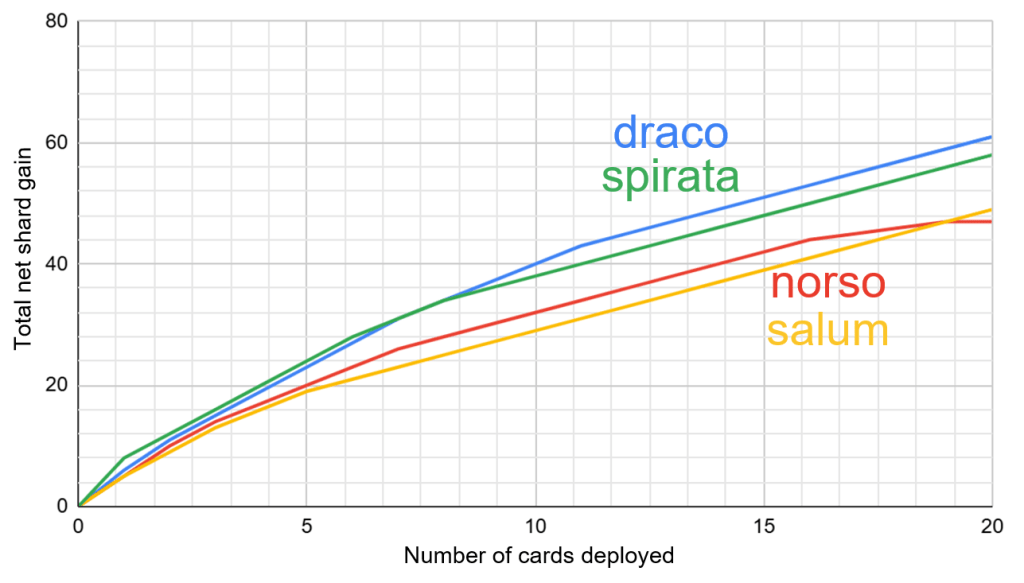
And there you have it. In terms of 2-turn absolute value, Draco and Spirata are the winners, with the best 5 or 6 cards in Spirata outstripping the best 5 or 6 draco cards, but the top 20 cards in Draco representing, on average, slightly better value than the top 20 Spirata cards.
This is not surprising. Rayders (Spirata) plays just a handful of the best value cards in the realm, and backs it up with high value trades and Full Palette (which isn’t included in this analysis). Draco Locations runs an astonishingly large number of high value cards which deploy to the canvas, resulting in a huge value resolve. No top tier Norso or Salum deck builds a board state in that way, with the best Norso deck relying on trading, and the best Salum deck either relying on Dark Rainbow, or Clunker and CLAIM effects.
For completeness, here’s the turn-3 value graph:
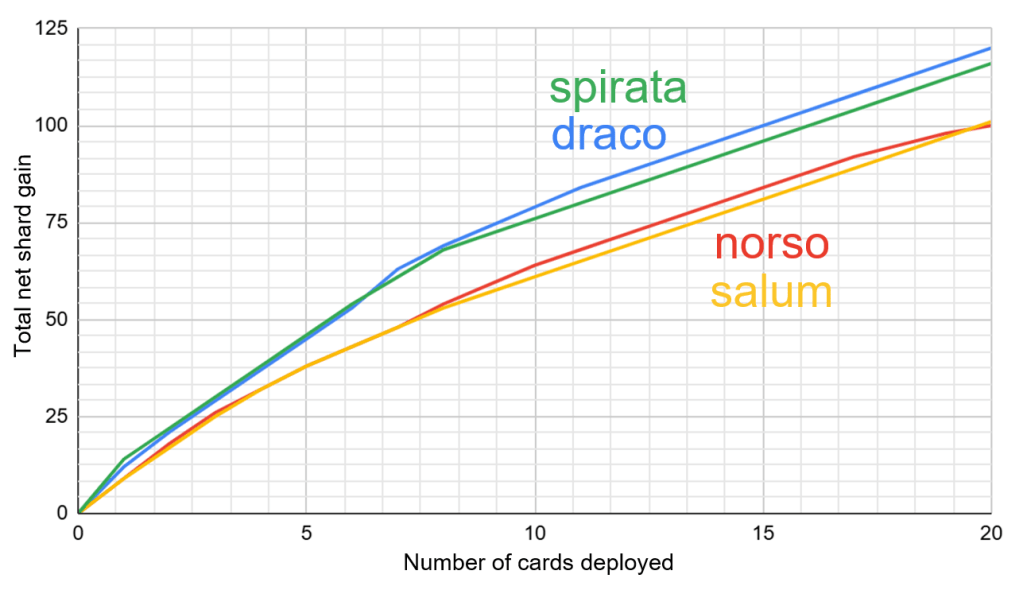
It’s broadly the same story, with Draco if anything looking slightly better value among its top cards.
So what’s the takeaway?
First of all, it’s clear that in the battle of the realms, Norso and Salum really are the poor cousins to Spirata and Draco. This isn’t a problem for Salum; it has the best tech and control in the game, which more than makes up for it’s lack of pure resolve. However, Norso, while it does have traders, is lacking both tech and pure resolve to keep up with the other realms.
The good news is that the new Norso expansion will double the card pool of characters and locations. Here’s hoping the resolve curve for Norso will be able to catch up, and open up this realm to a more interactive play style, suited to the Norse Gods who inhabit the realm.
Next time you’re ordering achroma products, please use the discount code dracotemple at checkout on the achroma webstore for 10% off all orders, including pre-orders. By using this code, you are also supporting me, as I also earn commission on any sales made using this code.
To activate this discount, enter the code at checkout, or go to https://fiverealms.co.uk/dracotemple to automatically apply the code.
 Draco Temple